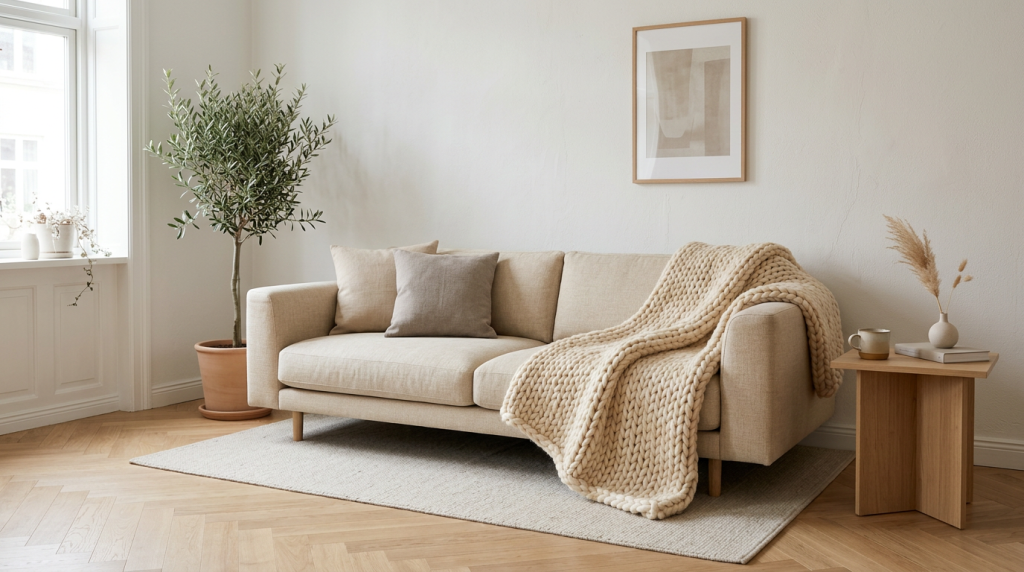
A warm minimalist apartment balances simplicity with comfort through materials, color, and light rather than a lot of objects. This page covers practical techniques across four areas: color, texture, materials, and lighting. Each section explains how to apply these elements in a way that feels both restrained and inviting. By the end, you’ll have a clear sense of which approaches suit your space and how to put them into practice.
Eleven Techniques Across Color, Texture, Materials, and Lighting
Color
1. Shift the base palette from cool white to warm white or off-white.
Repaint walls or choose bedding and large textiles in warm whites, creams, or soft beiges. This one change shifts the ambient tone of the entire space before you add any furnishings.
2. Anchor the room with a warm neutral color range across all large surfaces.
Keep walls, floors, and major furniture within a tight palette of whites, creams, light browns, and muted taupes. Staying within this range lets texture and material do the work without creating visual competition.
Texture
3. Lay a large, low-pile wool or jute rug to ground the space.
Choose a rug that extends well beyond the furniture footprint. It adds warmth and definition without adding objects. Stick to a single neutral tone to keep the floor plane clean.
4. Add a chunky knit or linen throw draped over a sofa or chair.
One throw, folded or loosely placed, adds tactile warmth without adding visual weight. Linen and undyed wool in natural tones fit cleanly into a neutral palette.
5. Place two or three cushions in natural fabrics on the main seating piece.
Keep the count low and the covers in the same tonal family: cream, oat, or warm grey. Varying the fabric (linen, cotton, boucle) adds texture without pattern or color contrast.
6. Layer a smaller woven textile over a bench or at the foot of a bed.
A flat-woven cotton or wool piece adds a second texture layer in a contained, low-profile way. When you keep it in the same neutral range as the rug, it looks intentional rather than accumulated.
Materials
7. Introduce wood through one or two functional pieces: a side table, shelf, or stool.
Choose pieces in a warm mid-tone wood like oak or walnut. The grain and warmth of the material carry significant visual weight on their own, so one or two pieces are enough.
8. Use linen for curtains or a duvet cover to bring organic texture to large surfaces.
Linen in natural, undyed, or warm white tones softens hard architectural lines without adding mass. Because it covers a large area, it shifts the feel of the room without introducing additional objects.
9. Bring in one or two ceramic or stone objects: a vase, a bowl, a candle holder.
Keep the forms simple and the tones warm. These materials add tactile and visual warmth at a small scale and sit cleanly on a shelf or surface without cluttering it.
Lighting
10. Replace cool-white bulbs with warm-white bulbs (2700K–3000K) throughout the apartment.
This is the lowest-commitment change on the list and affects every room immediately. Pair with dimmer switches where possible to control intensity by time of day.
11. Use floor lamps or table lamps with warm-toned shades to replace or supplement overhead lighting.
Directing light downward and outward from lower sources creates pools of warmth rather than flat, even illumination. A single lamp in a corner is enough to shift the atmosphere of a room.
Where to Start Based on What Your Space Needs
Applying changes across four categories means no single one has to carry the full load. The result is warmth that feels ambient rather than decorated. Negative space stays intact because each technique is bounded: one rug, one or two wood pieces, one lamp.
Where you start depends on what the space is missing. If it feels cold mainly because of its color tone, the palette and natural materials entries (1, 2, 7, 8) will have more immediate impact than texture layering. They shift the ambient feel before any soft furnishings are introduced. If you want a low-commitment starting point, a throw or a set of cushions (entries 4, 5) can be adjusted or removed without reorganizing the room. A large rug (entry 3) is the highest visual commitment on the list. It anchors the entire floor plane and affects how every other piece reads.
Lighting changes (entries 10, 11) work across every room at once and require no styling decisions, making them the most practical first step for a whole-apartment approach. Material and texture techniques, by contrast, are room-specific and work best when chosen in relation to what’s already in the space. In a living room, rugs, throws, and layered lamp lighting work together as a system. In a bedroom or hallway, linen textiles and wood pieces tend to carry more of the work since seating-based layering is less relevant.
Applying These Techniques by Room and Style
The living room is where most of these techniques come together most naturally. Anchor the floor with a large neutral rug, set the color range across walls and major furniture, and replace overhead lighting with one or two floor or table lamps. These three moves, applied together in a single room, produce the most complete version of the warm minimalist effect.
If you’re coming from a cozy-first orientation, the priority is restraint rather than addition. Choose one texture-rich piece, like a chunky throw or a boucle cushion set, rather than layering several. Hold the color palette to two or three tones within the warm neutral range. The goal is to edit down to what’s most intentional, not to accumulate softness.
Applying these techniques across multiple rooms requires consistency in material palette. Carry the same wood tone, the same linen or neutral textile family, and the same warm bulb temperature through each space. When the same materials and color range repeat from room to room, warmth reads as a considered decision rather than something that just accumulated over time.
These techniques are most relevant when a minimalist apartment feels sterile, cold, or visually flat despite being well-organized; when a living room needs warmth without clutter; when the goal is visual consistency across an entire apartment; or when the existing palette skews cool or stark white and needs a tonal shift before furnishings are reconsidered.
Starting Points for a Warmer Minimalist Palette
Lighting is the fastest lever. Swap in warm-white bulbs, add a floor lamp, and every room shifts immediately. From there, warm-toned surfaces and one natural material piece, like a wood side table or linen curtains, do more than any number of objects ever could. The minimalist structure stays intact, the coldness doesn’t, and if you’re ready to put this into practice, our room-by-room guide is a natural next step.
Comments
Comments are closed for this post.