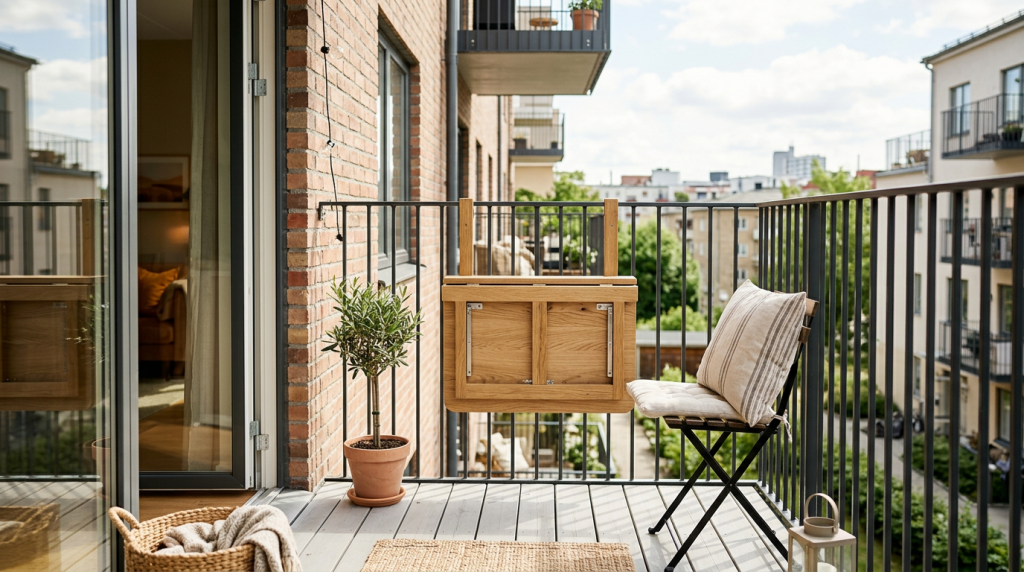
Outdoor furniture ideas for small spaces come down to picking pieces that fit without blocking movement or making the layout feel cramped. This page covers specific, purchasable furniture types suited to balconies, patios, and rooftops, including how each one works within common size and weight constraints. Every option here was chosen based on how it performs in tight spaces, not open backyard settings. By the end, you’ll know which furniture types suit your space and feel ready to make a purchase.
Furniture Types That Work in Compact Outdoor Areas
Ten formats consistently perform well across small balconies, patios, and rooftop spaces. Each is listed with the conditions it suits best.
Folding Bistro Set: A two-chair-and-table set that folds flat against a wall or into a storage corner when not in use. Works on the smallest balconies where a permanent setup would block the floor entirely.
Stackable Chairs: Individual chairs that nest vertically, freeing up floor space when guests aren’t around. Powder-coated steel or polypropylene versions hold up in the weather without needing covers or storage.
Modular Sectional Seating: Individual seat and corner units you can arrange in an L-shape, straight line, or split configuration. Particularly useful on patios with irregular dimensions or an awkward corner to work around.
Wall-Mounted Folding Table: A table that brackets directly to a wall or railing and folds down when not in use. Good for balconies where the floor is too tight for a freestanding table-and-chair setup.
Slim Two-Seat Loveseat: A compact sofa-style piece, typically under 50 inches wide, that gives you lounge seating without the footprint of a full sectional. Resin wicker over an aluminum frame keeps the weight manageable and holds up against moisture.
Low-Profile Lounge Chair: A single reclining or fixed-angle chair with a shallow depth. Works well on rooftop spaces where keeping furniture low cuts down on wind resistance and keeps sightlines open.
Ottoman with Storage: A dual-function piece that works as extra seating, a footrest, or a side table while hiding cushions or accessories inside. Useful on patios where there’s no nearby storage.
Corner Sectional Set: A seating configuration built to fit into a 90-degree corner, anchoring a defined zone along two walls or fence lines. Leaves the center of a small patio open instead of eating it up.
Narrow Bar-Height Table with Stools: A tall, slim table paired with two bar stools. It takes up less floor space than a standard dining set at the same seating capacity. Works on balconies with railing access or patios used mainly for dining.
Lightweight Aluminum Side Table: A small accent table you can move easily alongside any seating setup. Light enough to bring indoors during the off-season without any real effort.
Format, Material, and Scale: Tradeoffs Worth Understanding
Picking the right piece involves more than matching dimensions to floor area. Format, material, and scale each come with tradeoffs that play out differently depending on the space.
Folding and stackable formats, like the bistro set and stackable chairs, give you the most storage flexibility but aren’t as stable as fixed pieces like the corner sectional or slim loveseat. On windy rooftops or upper-floor balconies where furniture shifts around, that tradeoff is worth thinking through. Modular sectional seating adapts to irregular layouts and can be split across zones, while pre-configured sets like the corner sectional or narrow bar-height table-and-stool pairing work better in spaces with predictable, defined dimensions.
Material affects both durability and how easy the piece is to move. Lightweight aluminum pieces, like the side table, loveseat frame, and low-profile lounge chair, are easier to reposition or bring indoors seasonally. Heavier materials like teak or dense resin wicker are more stable but take more effort to store or relocate. Powder-coated steel and polypropylene hold up in the weather without covers, making them low-maintenance options for spaces without covered storage.
Scale affects usable floor space differently depending on the surface. On a balcony, even a slim loveseat can limit how you move around. That same piece on a ground-level patio leaves room to walk around it without the space feeling blocked.
Furniture Selection by Space Type
Small Balcony
The tightest constraint here is floor area, and in upper-floor buildings, weight is a secondary concern. Folding bistro sets, wall-mounted folding tables, and stackable chairs are the most practical options. Each one can be cleared from the floor entirely when not in use, leaving a clear path to the railing.
Small Patio
Ground-level patios can handle heavier and more permanent setups without load concerns. Corner sectionals and modular seating work well here because they anchor a defined zone along the perimeter, keeping the center of the space open instead of breaking it up with scattered pieces.
Rooftop Area
Wind exposure and building weight limits are the main filters. Lightweight aluminum pieces and resin wicker over aluminum frames are the practical defaults. Low-profile options like the lounge chair cut down on wind resistance and keep sightlines clear across the roofline.
Arrangement and Layout
How you place furniture matters as much as what you buy in a tight space. Pushing seating to the perimeter, like running a corner sectional along two walls or positioning a loveseat against a railing, keeps the center open and makes the space feel bigger. Picking one anchor piece and building around it, rather than spreading multiple small items across the floor, creates a defined zone that feels intentional rather than cluttered.
When This Guidance Applies
This applies directly to four situations: furnishing a small apartment balcony that currently has no outdoor furniture; replacing oversized patio furniture that limits movement or blocks usable floor area; setting up a rooftop space where wind exposure and weight restrictions narrow the options; and rearranging existing furniture in a tight outdoor layout to improve circulation and function.
Matching Furniture Format and Material to Your Balcony, Patio, or Rooftop
Your most binding constraint, whether that’s floor area, weight, or wind exposure, should drive every decision. Balconies favor folding and stackable formats. Rooftops call for lightweight aluminum or resin wicker. Patios can handle heavier anchored pieces. Wherever you’re working, one strong anchor item beats several scattered ones. If you’re ready to shop with your space in mind, browsing by material or format is a good place to start.
Comments
Comments are closed for this post.