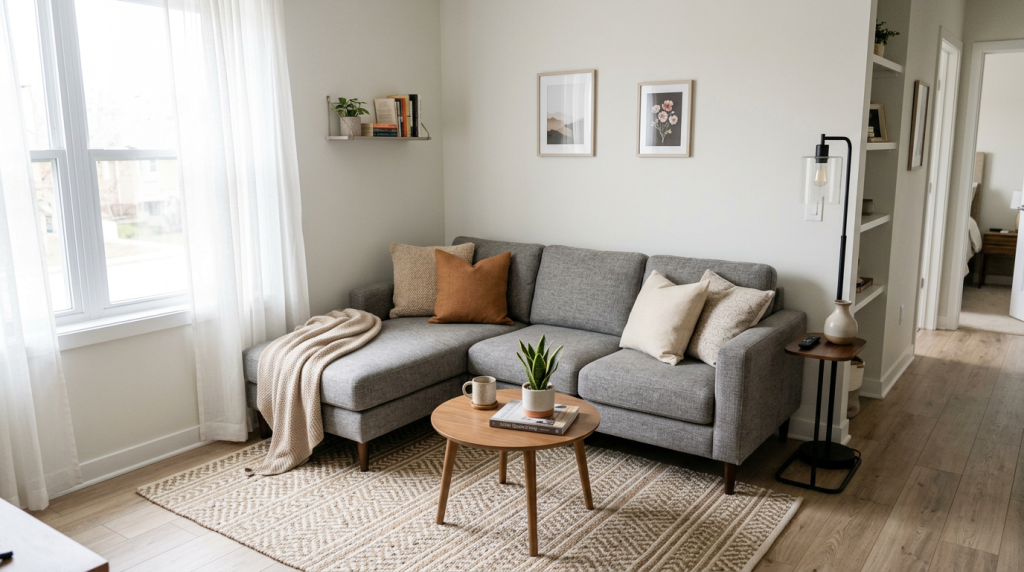
A small sectional can work really well in a small living room, but only if the size and shape match your room’s layout. This page covers how to evaluate sectional configurations for tight spaces, what to measure before you buy, and which features tend to work best in smaller rooms. It also covers when a standard sofa is actually the better call, because depending on your floor plan, it might be. By the end, you’ll know whether a small sectional makes sense for your space and, if so, what to look for when picking one.
Small Sectional Configurations Ranked by Floor Space Impact
The ten options below are organized by configuration type and how each one affects floor space and traffic flow, the two things that actually determine whether a sectional fits a small room.
- Chaise Sectional (Compact) — A sofa with an attached chaise extension rather than a full second arm section. It sits against one wall and takes up only part of the adjacent floor area, making it the most space-efficient true sectional for rooms under 200 sq ft. Left- or right-facing orientation determines which corner it anchors, so measure both traffic paths before choosing a side.
- Compact L-Shape Sectional — Two equal-length sections meeting at a 90-degree corner. It tucks into a corner cleanly and keeps both legs of the L short enough to leave usable floor space in the center, but you need at least 8 to 9 feet of clear wall on each side to avoid blocking doorways or walkways.
- Reversible Chaise Sectional — Same footprint as a standard chaise sectional, but the chaise can be moved to either side. This is useful if you’re not sure about your final layout or think you might rearrange later. It removes the risk of buying a fixed configuration that doesn’t work for the room.
- Sectional with Built-In Storage — A chaise or L-shape sectional where the chaise base or ottoman section lifts to reveal storage. In apartments and studios where space for linens, bedding, or media is limited, this is a real functional gain. The footprint is the same as a non-storage version.
- Sleeper Sectional (Compact) — A small sectional with a pull-out bed or fold-flat chaise built in. In a studio or one-bedroom apartment, this can replace both a sofa and a guest bed, making it one of the few cases where a sectional beats a standard sofa on pure square-footage value.
- Apartment-Scale L-Shape (Under 100 inches per side) — More manufacturers are now making L-shapes with each section running 85 to 98 inches instead of the standard 110 to 120 inches. These fit rooms where a full-size L-shape would take over. Confirm the total diagonal measurement against your room’s usable corner space before buying.
- Ottoman-and-Sofa Modular Configuration — A standard sofa paired with a separate matching ottoman that can be used as a chaise or pulled away as a coffee table. This is not technically a sectional, and in rooms under 150 sq ft or with irregular layouts, it often works better than a fixed sectional because it keeps your traffic flow flexible.
- Curved or Rounded Sectional (Small-Scale) — A compact sectional with a curved shape instead of a hard 90-degree corner. It softens the room visually and can work well in square rooms where a sharp L-shape would feel rigid. The curved footprint is harder to measure accurately, so account for the full arc, not just the endpoints.
- Standard Sofa (When a Sectional Doesn’t Fit) — If you have less than 7 feet of clear wall on either side of the corner you’re considering, or if the only viable placement blocks a doorway or main traffic path, go with a standard sofa. A sectional that gets in the way of moving through the room is worse than no sectional.
- Modular Sectional with Removable Pieces — A sectional built from individual connectable units that can be reconfigured or reduced. It lets you shrink the sofa if the room’s use changes, which is useful in rentals or rooms that double as home offices. The per-piece cost is usually higher than a fixed configuration.
Storage and sleep conversion only come up where they actually change the decision, specifically in apartment and studio contexts, rather than being treated as selling points across every option.
Chaise vs. L-Shape vs. Standard Sofa: How Each Handles Floor Space
The chaise sectional and compact L-shape both anchor a corner, but they use floor space differently. A chaise extends along one wall and leaves the center of the room open. An L-shape claims two walls and creates a more enclosed seating area. Which one works better depends on whether you want open floor space or a contained layout.
In a studio or apartment where you also need a guest bed or storage, a sleeper sectional or a sectional with built-in storage can be worth the larger footprint. The functional gain offsets the floor space cost in a way it wouldn’t in a room that already has dedicated storage. If the clear wall on either side of your corner runs under 8 feet, an apartment-scale L-shape (under 100 inches per side) is a better fit than a standard compact L-shape, which needs at least 8 to 9 feet of clear wall on each side to avoid blocking circulation.
Layout Decisions by Room Type and Configuration
Apartment or Studio Living
In a studio where seating, sleeping, and storage are all competing for the same square footage, focus on the sleeper sectional or the sectional with built-in storage. A compact sectional with these features can outperform a standard sofa even in very tight spaces.
Sectional vs. Standard Sofa
Before committing to a sectional, check three things: whether you have at least 7 feet of clear wall on each side of the intended corner, whether a sectional would block a doorway or main traffic path, and whether corner placement is even possible. If any of those conditions isn’t met, a standard sofa is the better choice.
Chaise Sectional Orientation
Left-facing versus right-facing placement determines which traffic path the chaise extends into, so measure both sides of the corner before picking an orientation. Chaise sectionals work best in rectangular rooms where one wall is longer and the chaise can extend along it without cutting off the main path through the room.
When a Small Sectional Makes Sense
A small sectional is the right call when corner placement is available and you have at least 7 to 8 feet of clear wall on each side. It also makes sense in an apartment or studio where seating needs to double as storage or sleeping space, in a room where a chaise sectional’s single-wall footprint leaves more open floor area than a standard sofa-plus-coffee-table setup would, and in a rental or flexible-use space where a modular sectional can be reconfigured or reduced as the room’s function changes.
Matching Configuration Type to Your Room’s Actual Conditions
Start by measuring both wall lengths flanking your intended corner. That one step rules out most configurations before you’ve committed to anything. If dual-use function matters, a storage or sleeper sectional justifies its footprint in ways a standard sofa simply can’t. The right configuration isn’t the most popular one. It’s the one your room’s actual dimensions support, and if you’re still narrowing it down, browsing sectionals filtered by size is a practical next step.
Comments
Comments are closed for this post.