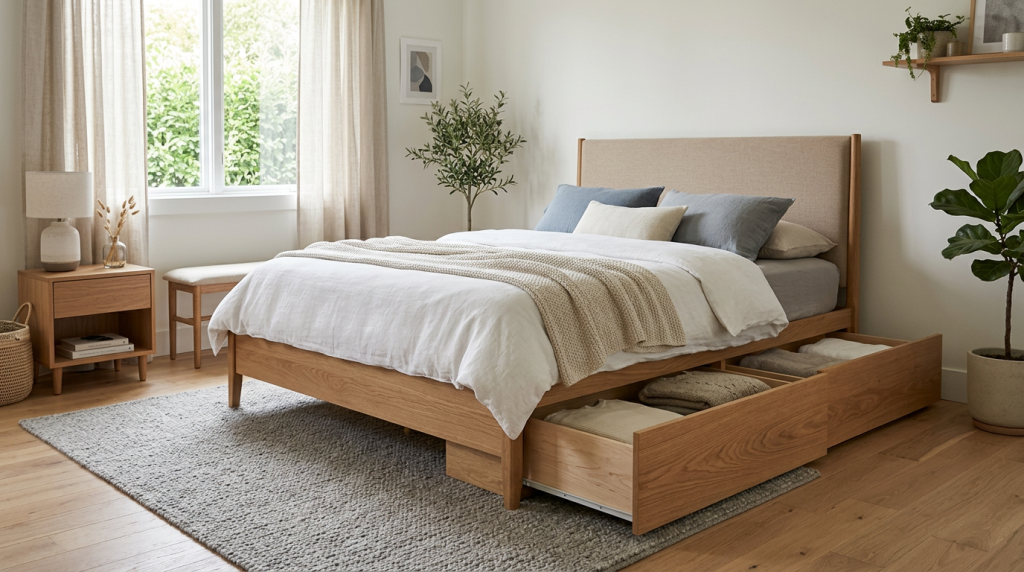
Choosing between a platform bed and a storage bed comes down to two things: how much built-in storage your bedroom needs and how much you want to spend. Platform beds give you a low-profile frame with no extra features. Storage beds add built-in drawers or a lift-up base so you can stash things underneath. This page covers the main differences in construction, cost, and use cases for each type. By the end, you’ll have a clear enough picture to decide which one fits your room and lifestyle.
How Platform Beds and Storage Beds Are Built
A platform bed is a low-profile frame that holds a mattress directly on a solid or slatted base, with no box spring needed. The design is about clean lines and a simple look, not storage.
A storage bed builds compartments right into the base. These come in two setups: drawer-style, with pull-out drawers along the sides or foot of the frame, and lift-up, where the mattress platform hinges upward to open a full under-bed cavity.
Platform Bed vs. Storage Bed at a Glance
| Attribute | Platform Bed | Storage Bed |
|---|---|---|
| Storage Capacity | None — no built-in storage | High — drawer-style offers moderate volume; lift-up offers full under-bed access |
| Aesthetics | Low-profile, clean lines, minimal visual weight | Bulkier frame profile due to integrated compartment structure |
| Airflow Beneath Mattress | Open base allows air circulation | Enclosed base restricts airflow under the mattress |
| Mattress Support | Solid or slatted surface provides direct, even support | Comparable support surface, but base construction varies by mechanism |
| Cost | Generally lower price point | Higher cost due to built-in compartment hardware and construction |
| Access Mechanism | Not applicable | Drawer-style: pull-out access without disturbing the mattress; lift-up: full cavity access, requires clearance to operate |
| Room Footprint | Minimal — frame sits close to floor | Larger vertical and side footprint to accommodate storage compartments |
Storage Capacity, Cost, and Airflow: The Deciding Factors
Three differences tend to drive the final decision. First, cost: platform beds are cheaper upfront, but a storage bed can close that gap by replacing a separate dresser or wardrobe. Second, storage setup: lift-up beds hold more than drawer-style, but need open floor clearance to work. If the bed sits against a wall, drawer-style is your only real option. Third, airflow: platform beds let air move under the mattress, while storage beds seal that space off completely. Over time, that enclosed base can trap moisture, which matters for mattress longevity in humid climates.
Variations Worth Considering
Not every choice falls cleanly into one category. A platform bed with built-in drawers sits in the middle. It keeps the low-profile look of a standard platform frame while adding some under-bed storage, which makes it a solid middle ground if you want clean lines but don’t want to give up all your storage space.
At queen size, storage beds offer noticeably more volume than twin or full versions, so the size upgrade is worth it if capacity is what you’re after. Queen-size frames do need enough floor clearance on the sides for drawer access, or open space at the foot of the bed if you’re going with a lift-up.
In a small bedroom, the trade-off is simple: visual minimalism versus storage volume. Lift-up storage beds use every inch of under-bed space. Standard platform beds keep the visual footprint low but add no storage, which may mean making trade-offs elsewhere in the room.
Matching Bed Type to Your Situation
The right choice depends on what your room actually needs. If you’re short on closet or wardrobe space, a lift-up storage bed gives you the most capacity. If you’re going for a minimal look and storage isn’t a concern, a standard platform bed is the straightforward answer. In a small bedroom where floor space is tight, either a lift-up storage bed or a platform bed with drawers can work. Which one is right depends on where the bed sits relative to the walls. If budget is the main factor and you don’t need built-in storage, a platform bed is the lower-cost option.
Which Bed Type to Buy Based on Storage Needs and Room Constraints
Storage needs and room layout will almost always point you toward the right choice. Lift-up beds work best when you need maximum capacity. Drawer-style beds make more sense when wall placement limits your access. Platform beds are the right call when budget or aesthetics come first. One thing that’s easy to miss: the wrong choice usually comes down to room clearance, not personal preference. If you’re still weighing options, browsing curated bed comparisons by room size can help you narrow it down faster.
Comments
Comments are closed for this post.