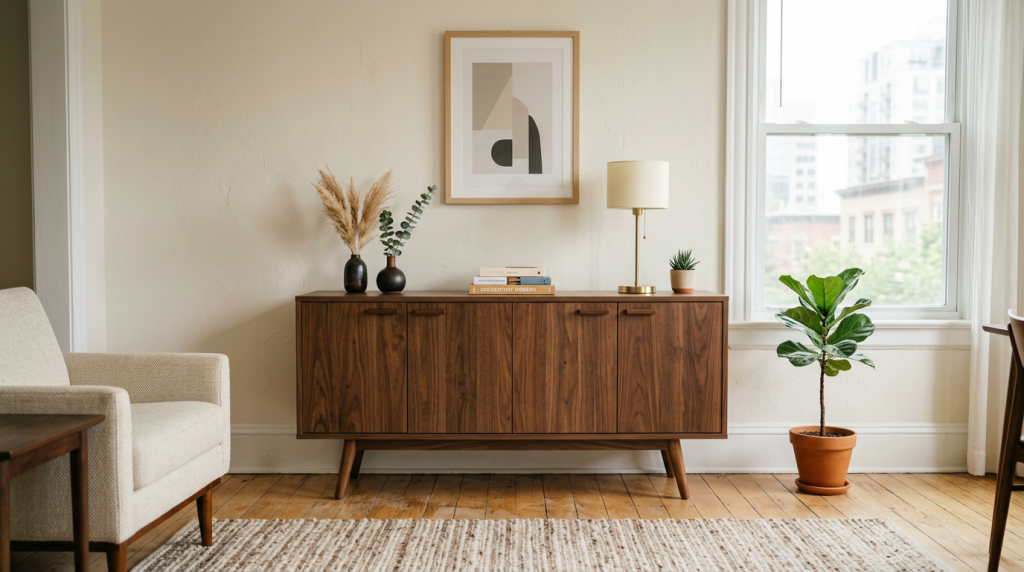
Mid-century modern furniture works well in smaller living spaces because of its low-profile frames, tapered legs, clean lines, and pieces that pull double duty. This page covers what defines the style and how to use it in different rooms. By the end, you’ll have enough to go on to pick pieces and arrange them in a way that fits your space.
Ten MCM Furniture Ideas Across Living Room, Bedroom, Dining, and Home Office
The ten pieces below cover the rooms most people are actually furnishing. Each one is rooted in at least one core MCM characteristic, and several do more than one job — which matters in urban homes where you rarely have room for furniture that only does one thing.
- Walnut-finish credenza with tapered legs — A low-profile storage unit with warm wood tones and clean cabinet fronts; works as both a media console and entryway storage in tight floor plans.
- Tufted low-profile sofa with splayed legs — A living room anchor with an organic curved back and a low frame that keeps sightlines open in smaller spaces.
- Hairpin-leg dining table with solid wood top — A slim table with exposed warm wood grain and minimal visual weight; seats four without taking over a narrow dining area.
- Multifunctional storage ottoman with MCM upholstery — Works as seating, a footrest, and hidden storage; the clean-lined silhouette with a tapered base fits a living room or bedroom equally well.
- Platform bed with integrated nightstand shelving — A low-profile bed frame in warm walnut or teak with built-in side shelving, so you don’t need separate nightstands.
- Eames-style molded shell chair — A single-piece organic curved seat on tapered wire or dowel legs; works as a desk chair, accent chair, or dining seat depending on where you put it.
- Compact MCM writing desk with open shelving — A narrow desk in warm wood with clean open shelves above; pulls off home office and display duties without needing a dedicated room.
- Sputnik-style pendant or arc floor lamp — A sculptural MCM lighting piece with clean geometric lines; defines a seating zone in open-plan layouts without taking up floor or surface space.
- Cane-back accent chair with tapered wood legs — A compact seat with organic texture; fits well in bedroom corners or as secondary living room seating where a full armchair would crowd things.
- Modular MCM shelving unit in warm wood tones — A wall-mounted or freestanding open shelving system with clean horizontal lines; adapts to a living room, home office, or dining room as storage and display.
Warm Wood Tones, Low Profiles, and Authentic Craftsmanship: What to Weigh When Selecting MCM Pieces
Three decisions come up again and again when furnishing in MCM style, and each one affects how a space looks and feels.
The first is the balance between warm wood tones and upholstered surfaces. Pieces like the walnut credenza or platform bed bring material warmth to a room, while upholstered options like the tufted sofa or storage ottoman soften the palette. Mixing both keeps a space from feeling either too cold or too heavy.
The second is how low-profile silhouettes behave differently depending on the layout. In a small urban apartment, pieces like the platform bed and tufted sofa give the room visual breathing room. In an open-plan layout, that same low profile helps define zones without blocking sightlines across the floor.
The third is the difference between authentic MCM and MCM-inspired pieces. Authentic pieces have solid wood construction, visible joinery, and period-accurate proportions — things you’ll see in items like the hairpin-leg dining table or cane-back accent chair. MCM-inspired alternatives can replicate the look at a lower price, but they typically use composite materials and less precise detailing.
Applying MCM Furniture by Style Context and Floor Plan
How you approach these pieces depends on the interior you’re working with and how much of the home you’re furnishing.
If craftsmanship and material quality are what matter most to you, focus on pieces with solid warm wood construction, visible joinery, and period-accurate proportions. Tapered legs and organic curves are the clearest signs of authentic MCM design. If you’re bringing MCM furniture into an already-minimalist space, the focus shifts to silhouette and finish compatibility. Low-profile frames and neutral upholstery let MCM pieces fit in without clashing.
For a whole-home MCM look, anchor each room with one strong MCM piece, usually a seating or storage item, and let secondary pieces echo its finish or leg style. In compact urban homes, multifunctional pieces come first. Anything that combines storage with seating, or works across two rooms, should be chosen before you add anything purely decorative.
When MCM Furniture Is the Right Fit
MCM furniture makes sense in four situations: you’re furnishing a compact urban apartment and need pieces that do more than one thing without crowding the floor plan; you have a contemporary minimalist interior and want to bring in some MCM character through a small number of well-chosen pieces; you’re picking a single statement piece, like a sofa, credenza, or accent chair, to anchor a specific room; or you’re furnishing multiple rooms and want a consistent MCM look throughout.
Choosing MCM Furniture for Urban Homes: Where to Start
Start with multifunctionality. A storage ottoman or platform bed with built-in shelving earns its place before anything purely decorative does. One strong MCM anchor per room, built around warm wood tones and a low-profile frame, is genuinely enough to set the style. If you’re ready to find pieces that fit your space, browsing curated MCM collections by room type is a good next step.
Comments
Comments are closed for this post.