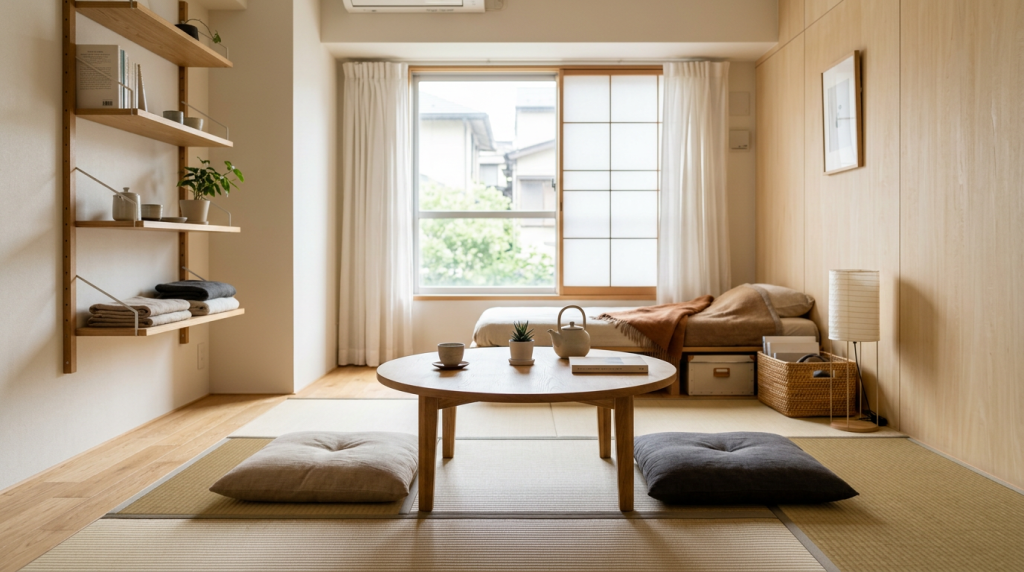
Japanese furniture ideas for small spaces are about making compact rooms work harder without feeling cramped or cluttered. This page covers practical furniture options for apartments where a single room needs to handle sleeping, eating, working, and relaxing throughout the day. Every piece here either folds away when not needed, combines two functions into one, or uses wall space and overlooked gaps. By the end, you’ll have a clear sense of which furniture types suit your space and how to rank them.
Ten Space-Saving Furniture Pieces for Compact Japanese Apartments
Futon (Shikibuton)
A floor-level sleeping mat that folds and stores in a closet during the day, turning the sleeping area into usable floor space. A good fit for 1K layouts where the bedroom and living area share the same room.
Low-Profile Dining Table (Chabudai or Kotatsu)
A low table used at floor level with zabuton cushions instead of chairs, which cuts out the vertical bulk of a standard dining set. A kotatsu version adds a built-in heater, so it works as both a dining surface and a warm lounge area in winter.
Murphy Bed (Wall Bed)
Folds flat against the wall when not in use, giving back the full floor area of a bedroom zone. Best for 1K and studio-equivalent apartments where sleeping and living functions share a single room.
Foldable Desk
Mounts to the wall or folds out from a compact frame, then collapses flat when the workday ends. It keeps a dedicated work zone functional without permanently taking up floor space.
Storage Ottoman
Works as seating, a footrest, and a hidden storage unit, replacing the need for a separate coffee table and storage box. A good fit for 1DK layouts where the living area is small but separate from the sleeping zone.
Platform Bed with Integrated Drawers
Keeps the sleeping surface low, in line with Japanese-style interiors, while using the space underneath for clothing or bedding storage. That removes the need for a separate dresser. Best for 1DK and 1LDK formats where the bedroom is a defined but compact room.
Modular Shelving Unit (Wall-Mounted)
Attaches to the wall to store books, kitchenware, or décor without eating into floor space. You can configure it in width and height to fit the irregular wall layouts common in older Japanese apartment buildings.
Nesting Tables
A set of two or three tables that stack inside each other when not in use, taking up the footprint of a single small table. Pull out individual pieces when hosting or working, then stack them back in a corner.
Sofa Bed
Switches between a compact sofa and a sleeping surface, making it a practical choice for a 1K apartment where a separate bed and couch wouldn’t both fit. Less useful in 1LDK formats where a dedicated bedroom already exists.
Slim Storage Tower (Slit Cabinet)
A narrow vertical cabinet, typically 15 to 25 cm deep, designed to fit into the gap between a refrigerator and a wall or between two pieces of furniture. It adds real storage without needing a dedicated floor zone.
Why This Selection Works for 1K, 1DK, and 1LDK Layouts
This list tackles two distinct problems at once. Foldable pieces like the futon, Murphy bed, and foldable desk eliminate their floor footprint entirely when not in use. That matters most in 1K apartments where a single room handles everything. Storage-integrated pieces like the platform bed with drawers, storage ottoman, and slim storage tower reduce the total number of items a room needs to hold. That matters more in 1DK and 1LDK formats where zones are separate but space is still tight.
Several items go further by replacing an entire furniture category. The storage ottoman stands in for both a coffee table and a storage box. The platform bed with drawers removes the need for a dresser. In a 1K or 1DK apartment, one unnecessary item can make a room feel non-functional, so pieces that cover two roles at once carry real weight. Low-profile forms like the chabudai and futon also reduce the visual and physical density of a room without sacrificing utility. That’s a practical consideration in apartments where both ceiling height and floor area are limited.
Foldable vs. Storage-Integrated: Choosing the Right Approach
The choice between foldable and storage-integrated pieces comes down to what the room needs most. If floor space is the main problem, foldable and collapsible pieces are the stronger pick because they eliminate their footprint entirely when not in use. Storage-integrated pieces work better when the room has a fixed layout and the goal is reducing the number of furniture items rather than reclaiming open floor area.
Within the sleeping category, the futon, sofa bed, and Murphy bed each suit a different situation. In a 1K apartment where sleeping and living share one room, the futon offers the most flexibility because it stores completely out of sight. The Murphy bed reclaims floor space but needs wall clearance. The sofa bed is the practical middle ground when you also need a seating surface during the day.
Low-profile forms like the chabudai and floor cushions keep the room visually open but offer no storage. If the apartment lacks closet space, going with storage-integrated pieces over low-profile aesthetic choices will have more practical impact. Modular shelving and nesting tables adapt to irregular wall layouts and changing needs, which is useful in older Japanese apartment buildings where dimensions are non-standard. Fixed pieces like the platform bed or sofa bed need accurate measurements before you buy and offer less flexibility if the layout changes later.
Furniture Combinations by Apartment Type and Priority
1K and Studio Formats: Maximum Space Efficiency
For the smallest formats, focus on pieces that disappear when not in use. The futon stores in a closet, the Murphy bed folds flat against the wall, and the foldable desk collapses between uses. Nesting tables and the slim storage tower add function in gaps and corners without claiming dedicated floor zones.
Japanese-Style Aesthetic with Functional Constraints
Low-profile pieces like the chabudai or kotatsu, futon, and floor cushions fit naturally with a Japanese-style interior while also cutting the vertical bulk of conventional furniture. The wall-mounted modular shelving unit keeps surfaces clear and walls functional, which works for both the aesthetic and the practical problem of limited floor space.
Whole-Room Layout Across Sleeping, Dining, Working, and Storage
A low dining table paired with zabuton cushions, a wall-mounted shelving unit, and a futon stored during the day can cover sleeping, dining, and storage across a single compact room without any piece duplicating another’s floor footprint. Adding a foldable desk to that setup introduces a work zone that activates and disappears on demand, keeping the room functional across all daily uses without needing zone separation.
When to Apply This Furniture Approach
This approach makes sense when furnishing a 1K or 1DK apartment where a single room must handle sleeping, dining, and living at the same time or in sequence; when setting up a Japanese-style apartment interior where low-profile, minimal-footprint furniture is both a design preference and a practical requirement; when choosing furniture that covers sleeping, dining, working, and storage within a compact layout without duplicating floor space use; or when replacing single-purpose furniture with multifunctional or foldable alternatives to recover usable floor area in an already-furnished small apartment.
Matching Furniture to Apartment Format and Storage Constraints
The real decision in a compact Japanese apartment isn’t which piece looks best. It’s whether floor space or storage is your binding constraint. Foldable pieces like futons and Murphy beds solve the first problem; platform beds with drawers and modular shelving solve the second. Trying to fix both at once usually means solving neither. Figure out your single limiting constraint first, then look at furniture options built specifically around it.
Comments
Comments are closed for this post.