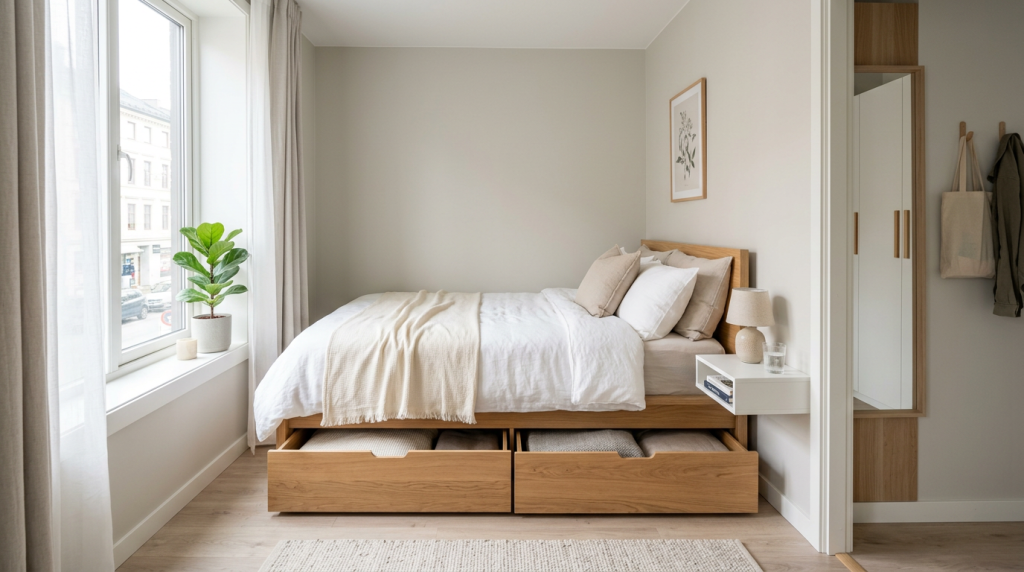
Bedroom furniture sets for small apartments are built to make limited floor space work harder while keeping the room functional and put-together. This page covers the core furniture pieces most relevant to small bedrooms: bed frame, dresser, nightstand, and chest. It explains whether buying them as a matched set or separately makes more sense for your situation. Each piece is ranked by purchase order, starting with what the room needs right away and ending with what can be added later or skipped. By the end, you’ll have a clear basis for deciding which pieces to buy, in what order, and how to approach the set-versus-separate question.
Bedroom Furniture Pieces for a Small Apartment, Ranked by Priority
The list is ordered this way on purpose. Most matched bedroom sets are designed for standard-sized rooms, not small apartments, which means a full 5- or 6-piece set can eat up usable walking space before you realize it. A chest and dresser in a 10×10 room, for example, compete for the same floor space. The priority order also helps you avoid the most common budget mistake: spending everything on a matched set before confirming all the pieces fit, or buying secondary storage before you have a functional bed frame.
- Bed frame with under-bed storage — the anchor piece of any bedroom setup; drawer or lift-storage versions recover floor space that a standard frame wastes.
- Dresser — your main clothing storage and the piece most commonly paired with a bed frame in matched sets; a 5- or 6-drawer configuration handles what a small closet can’t.
- Nightstand with shelving or drawer — keeps essentials off the floor and off the bed; one nightstand is enough in tighter rooms where two would crowd the layout.
- Chest of drawers — secondary storage for overflow clothing or linens; pairs with a dresser in most matched sets and earns its footprint when closet space is tight.
- Wardrobe or freestanding closet — only relevant when the apartment has no built-in closet; a narrow, single-door unit can fill that gap without taking over the room.
- Dresser mirror — commonly included in matched bedroom sets; useful for daily use and adds perceived depth in a small room without taking up floor space.
- Bench or storage ottoman at the foot of the bed — low priority; useful for seating and extra storage, but only practical when the room has enough clearance at the foot of the bed.
Leading with the bed frame and dresser covers the basics first and leaves room in the budget for additions only if space allows.
Matched Set vs. Individual Pieces: The Trade-offs That Matter in a Small Room
Bedroom sets are designed as coordinated collections, not sized for specific rooms. That distinction matters more in a small apartment than anywhere else. The dresser, chest, and nightstands in a 5-piece set may be proportioned for a larger room than a small apartment can handle. Buying individually lets you pick each piece for its actual dimensions, not just its match to a collection. The trade-off is that matched sets offer visual cohesion and a bundled price, and those advantages disappear if the pieces don’t fit.
A 2-piece set, bed frame and dresser, is the most space-efficient matched option. It gives you a coordinated look without committing to the full footprint of a 4- or 5-piece set, and it leaves the nightstand and chest as optional additions rather than assumed purchases. For small apartments, this is often a better starting point than a full set, even when the full set looks more cost-effective per piece.
Queen sets carry the widest price range of any configuration, but more pieces doesn’t mean better value in a tight space. A lower-priced 5-piece queen set may look like more for your money, but if two of those five pieces can’t fit without overcrowding the room, the effective value drops. Budget with what fits in mind, not just what’s included.
Queen Sets, 2-Piece Sets, and Dresser-Only Configurations
The right starting point depends on what the room already has and what the main gap is.
Queen sets are the most widely available configuration and span the broadest price range, making them the default starting point for most apartment shoppers. When a queen bed is the anchor piece, look for sets that bundle the bed frame with a dresser and one nightstand: the three pieces most likely to fit without consuming the full floor plan.
A 2-piece configuration, typically a bed frame and dresser, is the minimum viable matched option for buyers who want visual cohesion without committing to a full set. It keeps the flexibility to add a chest, nightstand, or mirror individually, sized and timed to what the room and budget can absorb.
When the main gap is clothing storage rather than a complete room refresh, a dresser and chest (or dresser and mirror) can be purchased as a standalone matched pair without involving the bed frame. This works well when a bed frame is already owned or when storage is the immediate need over visual cohesion.
Choosing Between a Bed Frame and Dresser First, or a Set
This applies directly if you’re furnishing a small apartment bedroom for the first time, deciding between a matched set and individual pieces, working within a set budget, or dealing with a room where square footage limits what can physically fit. In each case, the logic is the same: figure out which pieces earn their floor space, buy those first, and treat everything else as conditional on what the room can actually hold.
Prioritizing Fit and Function When Buying Bedroom Furniture for a Small Apartment
A bed frame and dresser cover the basics: sleep and clothing storage. Everything else depends on what the room can actually hold. Buying a matched set trades sizing flexibility for visual cohesion, which matters more in a tight space than it would in a larger room. Measure first, then decide how to buy. If you’re ready to compare options, browsing curated bedroom sets for small spaces is a practical next step.
Comments
Comments are closed for this post.