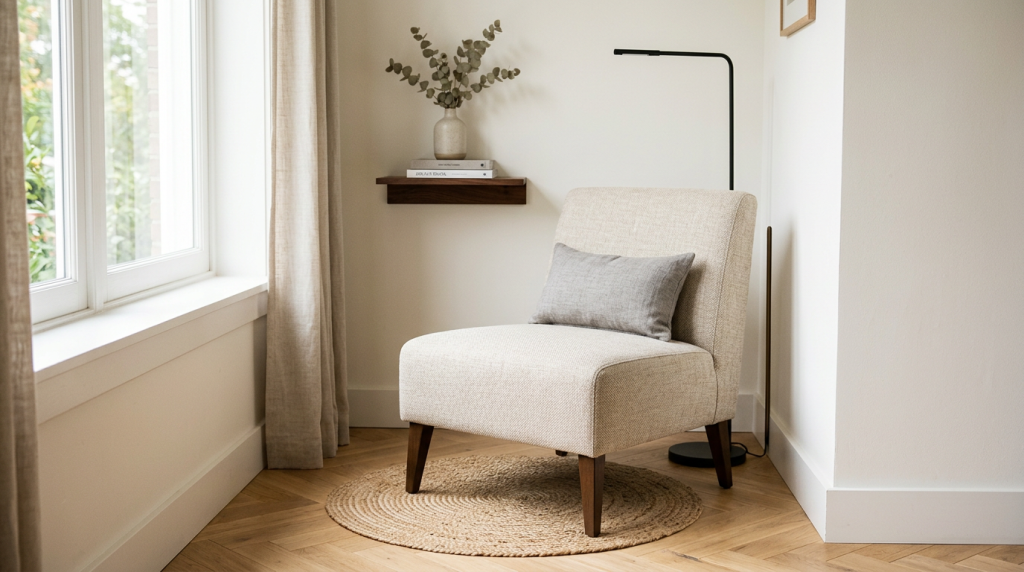
The best accent chairs for small spaces are compact, functional, and don’t eat up floor space you can’t spare. This page covers what to look for in a small-space accent chair: size ranges, proportions, and how different styles fit into tighter layouts. Most compact options measure under 30 inches wide, while standard accent chairs can reach up to 40 inches tall and still work when their width stays proportional to the furniture around them. By the end, you’ll have a clear sense of which chair dimensions and styles suit your room.
Seven Accent Chair Styles That Work in Small Rooms
Each style below stays within small-space size limits. The right choice depends on where the chair will go, whether it needs to pair with a sofa, and how much floor clearance you’re working with.
- Slipper Chair — Armless and low-profile, typically 28–30 inches tall and under 28 inches wide, making it the smallest-footprint option on this list. No arms means less visual bulk, and you can tuck it into corners or alongside beds where clearance is tight.
- Barrel Chair — Defined by a curved back and integrated arms that wrap the seat, usually 29–32 inches wide and 30–34 inches tall. The rounded shape keeps the visual footprint compact despite the arms, and it works well in living rooms and reading nooks.
- Accent Arm Chair (Tight-Back) — A straight-backed upholstered chair with modest arms, typically 28–32 inches wide and 32–36 inches tall. The upright profile takes up less visual space than a lounge-style chair and fits alongside a sofa without competing for floor area.
- Parsons Chair — A fully upholstered chair with no exposed frame, generally 25–28 inches wide and 33–36 inches tall. The clean, boxy shape reads as visually light, and the narrow width makes it one of the more space-efficient armed options.
- Wingback Chair (Compact Scale) — A high-backed chair with side panels, available in scaled-down versions that run 28–30 inches wide and 38–40 inches tall, which puts it at the upper limit of the standard accent chair range. It only works in small rooms in its narrower configurations. The vertical height draws the eye up without expanding the floor footprint.
- Accent Swivel Chair — A low-profile upholstered chair on a swivel base, typically 28–32 inches wide and 29–33 inches tall. The swivel means you don’t have to reposition the chair to face different parts of the room, which is useful in tight floor plans where furniture can’t be easily moved around.
- Cube Chair — A boxy, armless upholstered chair with a minimal frame, usually 26–30 inches wide and 28–30 inches tall. The square proportions keep it compact in both dimensions, and the armless design lets it tuck into corners or fit between other pieces without awkward gaps.
Why Size Thresholds and Sofa Alignment Determine Whether a Chair Works
The size limits above exist to solve a real problem: adding seating without crowding the furniture and walkways around it. Every style on this list stays within those limits, so none of them require you to rearrange your layout just to make them fit.
Seat height matters just as much as overall dimensions. In a small room, where everything sits close together, a chair whose seat height roughly matches the sofa creates a cohesive look. A big height difference draws attention to the mismatch rather than the room as a whole. Several styles, particularly barrel chairs and compact wingbacks, also work in larger rooms without looking undersized. That means a chair you pick for a small space won’t look out of place if the room or layout changes later.
Height, Arms, and Sofa Pairing: The Three Decisions That Narrow the Field
Chair height affects visual weight differently depending on the room. Chairs under 30 inches, like slipper chairs and cube chairs, keep the sightline low and open, which reduces visual density in very tight rooms. Chairs in the 30–40 inch range, like compact wingbacks and tight-back arm chairs, add vertical presence without expanding the floor footprint. That’s the better choice when ceiling height allows and the room needs visual anchoring rather than minimizing.
Armless and armed styles create different perceived footprints. Slipper chairs and cube chairs occupy only their seat width and can be placed flush against walls or other furniture. Barrel chairs and parsons chairs include arms but manage their footprint through curved or narrow profiles. The tradeoff is slightly more floor space in exchange for lateral support and a more defined seating boundary.
Seat height relative to a sofa is a real decision point. A barrel chair or accent arm chair with a seat height of 17–19 inches will match most standard sofas and read as a deliberate pairing. A slipper chair with a lower seat height works better as a standalone piece, in a bedroom corner or reading nook, rather than placed directly beside a sofa where the height difference becomes obvious.
Matching Chair Style to Specific Room Constraints
The right style depends on the specific constraint your room presents.
For the tightest footprint, slipper chairs and cube chairs are the main options that consistently come in under 30 inches in both width and height. These work best in bedroom corners, reading nooks, and any space where floor clearance around the chair is 18 inches or less.
When comfort matters as much as compactness, barrel chairs are the strongest option. Their curved back provides real support within a contained footprint, and a deeper seat or thicker cushion won’t push the chair into oversized territory as long as overall width and height stay within the established limits.
When the chair needs to work across room sizes, whether for a space that may change or a buyer who may move, barrel chairs, compact wingbacks, and accent arm chairs are the better picks. Their proportions are self-contained rather than minimized, so they look intentional in both tight and open layouts. Slipper chairs and cube chairs, by contrast, are built specifically for small spaces and can look too minimal in a larger room with heavier furniture.
When to Choose an Accent Chair Over Other Seating
In a small living room where a sofa already takes up most of the floor plan, a second seating piece needs to stay under 30 inches wide. A compact accent chair fits that constraint where an oversized chair doesn’t. A bedroom reading corner or window nook where you need to keep a clear path is well suited to an armless slipper chair or cube chair, since you can place either one without blocking a walkway. Oversized chairs and chaise lounges go beyond the 30–40 inch standard range and take up floor space a small room simply doesn’t have. That’s what makes the size-based case for an accent chair straightforward. If you’re furnishing a space that might change, a compact accent chair that works in both small and larger rooms is a smarter buy than something sized only for one context.
Choosing the Right Accent Chair for a Small Space
Chair width and seat height do more work than most people expect. A 29-inch slipper chair and a 38-inch oversized barrel chair can occupy the same room very differently depending on what surrounds them. For tight spaces, focus on width under 30 inches and a seat height that matches your sofa’s. If you’re ready to narrow it down, browsing chairs filtered by dimension is the most practical next step.
Comments
Comments are closed for this post.