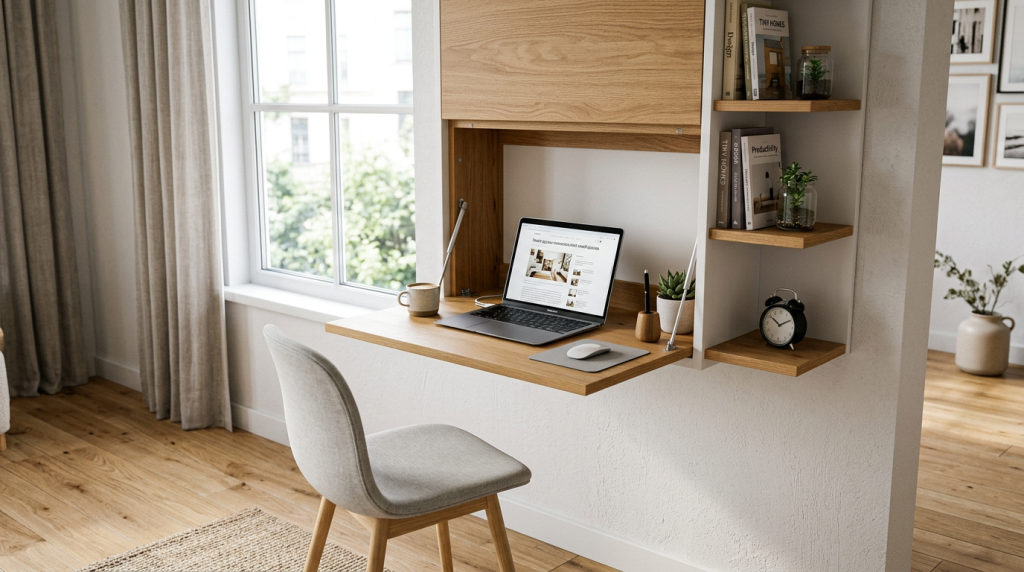
Small home office desk ideas for apartments are about getting a functional workspace out of a small room. This page covers nine desk formats, including wall-mounted, foldable, corner, and storage-integrated options, suited to different apartment layouts and rental situations. Each option stays under 48 inches wide and keeps the floor footprint small. By the end, you’ll have enough information to pick a desk style that fits your space and setup.
Nine Desk Configurations That Work in Apartments
Each option below tackles at least one of the three main apartment constraints: floor footprint, storage, or placement flexibility. Several tackle more than one at once.
- Wall-Mounted Fold-Down Desk — Mounts flush to the wall and folds flat when not in use, giving you your floor space back. Fits in as little as 24 inches of wall width.
- Compact Writing Desk — A freestanding single-surface desk in the 36–40 inch range with no overhead structure. Fits against any wall without anchoring.
- Corner Desk Configured for Small Rooms — Uses two existing wall angles to give you more surface area without pushing into the room. Most small-space corner desks fit within a 40–48 inch diagonal footprint.
- Foldable Portable Desk — Collapses flat for storage and sets up in any room. Most models are under 36 inches wide and weigh under 20 pounds.
- Compact Desk with Built-In Shelving — A 40–48 inch freestanding desk with an attached hutch or upper shelves, combining workspace and storage in one footprint.
- Secretary Desk — A hinged-front desk that closes completely when you’re not working, hiding the surface and everything on it. Typically 30–36 inches wide and looks like a cabinet when closed.
- Floating Shelf Desk — A wall-anchored shelf used as a standing or seated work surface. Can be as narrow as 10–12 inches deep, with widths starting at 24 inches.
- Narrow Ladder Desk — A freestanding unit with a small lower desk surface and built-in upper shelving. Fits in under 36 inches of wall space.
- Convertible Console Desk — A slim console-style table in the 40–48 inch range that doubles as a desk. Works well behind a sofa or along an entryway wall so it doesn’t take up dedicated floor space.
The list covers both fixed and flexible formats. Wall-mounted and freestanding options work for renters who can make permanent modifications. Foldable and freestanding alternatives work for those who can’t. That way the list stays useful across different rental situations without making you sort through options that don’t apply to you.
Trade-Offs Between Desk Types: Flexibility, Floor Space, and Storage
The right desk depends on which constraint matters most to you. Foldable and fold-down desks give you the most flexibility but trade off surface stability and permanence. Fixed desks, like the compact writing desk or corner desk, give you a more stable daily workspace but take up more floor space. Wall-mounted options like the fold-down desk and floating shelf desk free up the most floor space, but they require drilling, so they’re off the table for renters in strict no-modification units. Desks with built-in shelving or hutch attachments combine storage and workspace in one footprint, which can eliminate the need for extra furniture. Minimal desks like the compact writing desk or convertible console desk keep a low profile but depend on the storage around them to make up the difference.
Matching Desk Type to Apartment Layout
Minimum Footprint Priority
When floor space is the main constraint, like in a studio or shared room, wall-mounted and fold-down desks are your best bet. They clear the floor completely when you’re not using them. Desks in the 24–36 inch width range are most relevant here.
Storage-First Setup
When you don’t have much storage around you and the desk needs to carry some of that load, look at compact desks with built-in shelving, drawers, or hutch attachments. A 40–48 inch desk with integrated storage can often replace a separate bookshelf or filing unit.
Renter-Friendly Configuration
If you can’t drill into walls or make permanent changes, wall-mounted options won’t work for you. Freestanding compact desks, corner desks that use existing wall angles without anchoring, and foldable desks cover the practical range here.
Situations Where a Small Apartment Desk Is the Right Call
A dedicated desk makes sense in a few specific situations: working from home full- or part-time in a studio or one-bedroom with no dedicated office room; setting up a part-time workspace in a shared living area without permanently taking over common space; fitting a desk into a bedroom without it taking over the room; and using a desk in a space that does double duty, like an entryway, living room, or dining area, when the apartment has no single-use rooms.
Choosing the Right Desk Width and Format for Your Apartment
Start with your most limiting constraint: footprint, wall modifications, or storage. If you can’t drill, foldable and freestanding formats solve that cleanly. If storage is the problem, a desk with built-in shelving can quietly replace a separate storage unit. If you’re still comparing specific models, browsing desks filtered by dimension is a practical next step.
Comments
Comments are closed for this post.